


 New Papers
[1] Positivity of supercritical LYZ pairs
[2] Accelerating Langevin Dynamics with Weighted Laplacian Flow: Global Well-Posedness and Exponential Convergence
[3] Div-Curl Characterization of Surface Orientation
[4] ABJM/BMN Index Matching in the Plane-Wave Limit
[5] $L_p$-Integral Affine Surface Area-Variational Capacity Inequalities
Most Downloaded Papers
Mathematic Words Today
Stereographic projection

In geometry, the stereographic projection is a particular mapping (function) that projects a sphere onto a plane. The projection is defined on the entire sphere, except at one point: the projection point.
Mathematic People Today
Carl Friedrich Gauss
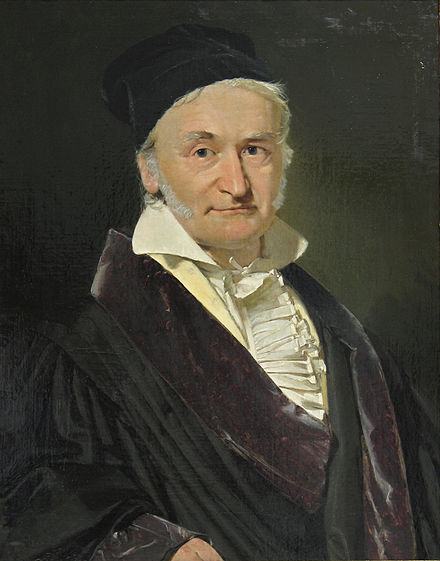
Johann Carl Friedrich Gauss was a German mathematician who contributed significantly to many fields, including number theory, algebra, statistics, analysis, differential geometry, geodesy, geophysics, mechanics, electrostatics, astronomy, matrix theory, and optics.
Popular Links
